Roof deck and existing damage
Identify tear-off assumptions, deck type, how damaged material is measured and priced, and who documents conditions that are not visible until the old covering is removed.
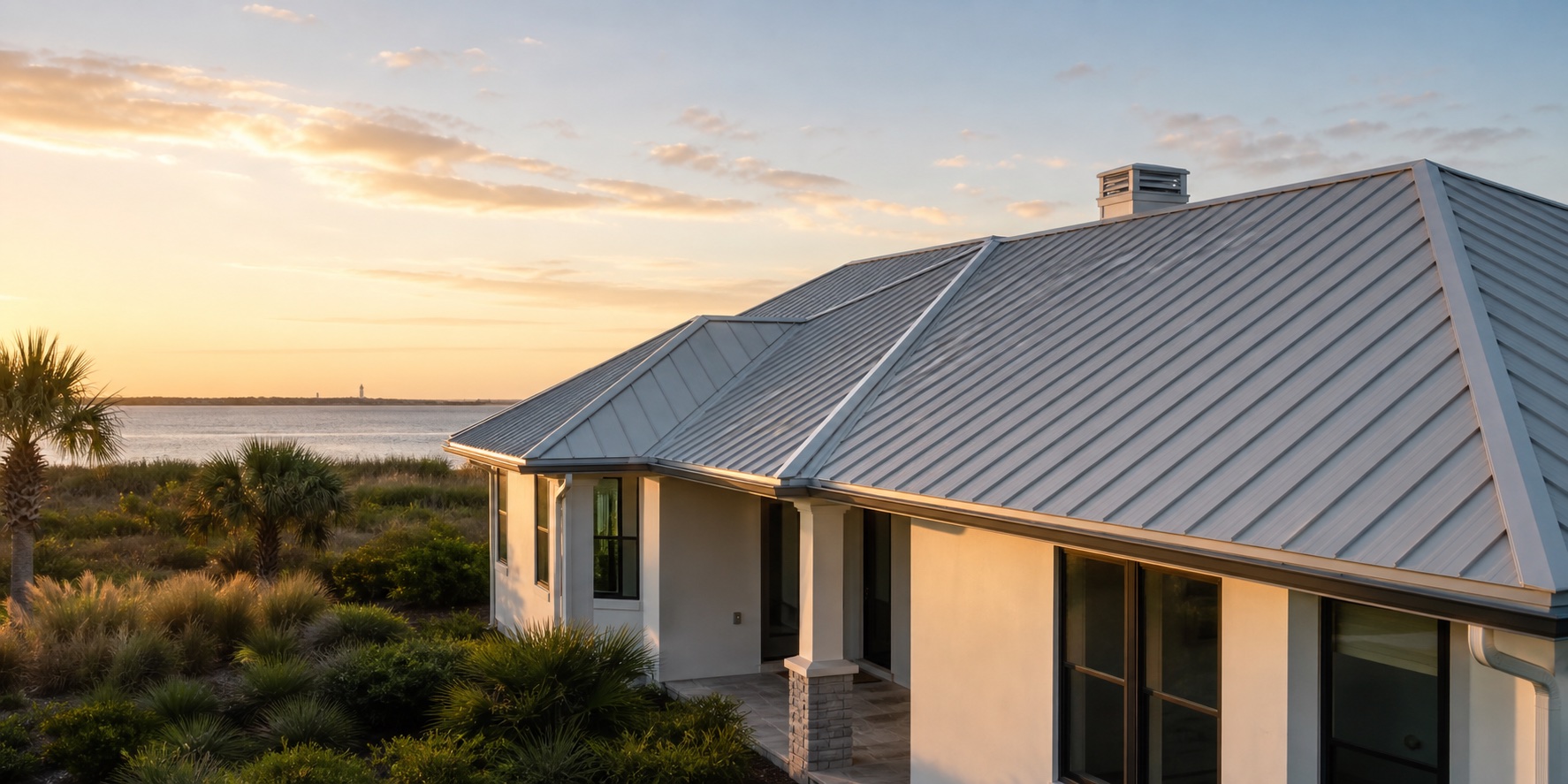
Metal roofing on Florida’s Space Coast
Understand panel systems, salt exposure, wind design and the questions worth asking before replacing or repairing a roof on Florida’s Space Coast.
What the coastline changes
A useful coastal proposal names the substrate, coating, panel profile, fasteners, flashing details and exact tested assembly. It also explains whether the written manufacturer warranty covers the property’s distance from breaking surf, a bay or brackish water. “Metal” by itself is not a specification.
Wind design is equally property-specific. Brevard County directs applicants to its address-based wind maps and risk categories. Ask for the design criteria, Florida Product Approval or other accepted evaluation, deck attachment and perimeter details that apply to your roof—not a single countywide mph slogan.
Roof system comparisons
Compare material names with the assembly details that determine whether a roof fits the building, the exposure and the written warranty.
Use the deck, underlayment, flashings, panel and attachment method—not a material label—to compare installation proposals.
Explore this systemLook beyond the tile, shake or shingle appearance to the base steel, coating, fastening method, flashings and marine exclusions.
Explore this systemCompare seam geometry, clips or concealed fasteners, substrate, finish, transitions and the approval for the exact roof assembly.
Explore this systemSeparate an isolated flashing or fastener problem from widespread coating, substrate, deck or installation failure before choosing a scope.
Explore this systemUnderstand the limited roof-age rule in Florida law, its exceptions, and the difference between statutory rights and a carrier’s other underwriting grounds.
Explore this systemSystem comparison
This is a decision framework, not a ranking. The right answer depends on roof slope, geometry, exposure, approved assembly, maintenance expectations and budget.
Panel profile, seam height, clip or fastening method and tested assembly
Substrate, PVDF or other finish, cut-edge treatment and written warranty distance
A premium label without the exact approval, details or installer qualifications
Panel fastening, batten or direct-to-deck method, flashings and repairability
Base steel, coating system, granule coverage and marine exclusions
Treating every profile and attachment method as interchangeable
Alloy, thickness, profile, clip spacing and compatible accessories
Coastal warranty terms, finish coverage, rinse requirements and dissimilar metals
Assuming corrosion resistance replaces wind-engineering documentation
Panel, fastener, washer, spacing, substrate and replacement-maintenance plan
Fastener compatibility, coating warranty and salt-related exclusions
Ignoring that exposed penetrations are recurring inspection points
Read the scope before the price
A clear scope makes competing proposals comparable and exposes assumptions before work begins.
Identify tear-off assumptions, deck type, how damaged material is measured and priced, and who documents conditions that are not visible until the old covering is removed.
Name the underlayment, valley approach, eave and wall transitions, penetrations, ventilation work and any low-slope areas that require a different assembly.
Record the manufacturer, profile, substrate, thickness, finish, color, accessories, marine warranty eligibility and any maintenance conditions in writing.
Ask for the product approval, design pressures or criteria, fastener or clip schedule, perimeter zones, edge metal, flashing details and permit responsibility.
Brevard County local guides
Barrier-island, riverfront and inland properties can demand different warranty and detailing conversations even when they share a ZIP code.
Mainland · river-to-inland variation
Start with the property address, roof geometry, and distance from open water rather than a citywide material assumption.
Open local guideMainland · planned-community details
Coordinate address-based wind criteria, association review and a complete roof-assembly scope before treating a material choice as approved.
Open local guideMainland · established-home conditions
Give deck condition, penetrations, tree-related wear and prior repairs the same attention as the proposed panel and finish.
Open local guideBarrier island · marine warranty review
Use the property’s distance and orientation to salt water to confirm substrate, finish, compatible accessories and written coastal coverage.
Open local guideBarrier island · mixed roof conditions
Confirm marine warranty eligibility and detail every transition among steep-slope, low-slope, wall and equipment conditions.
Open local guideMainland · river-to-inland variation
Use the exact lot and existing structure to assess open-water exposure, deck conditions, additions and proposal allowances.
Open local guideBroad inland geography · address-specific criteria
Palm Bay’s scale makes the exact address, permit jurisdiction, structure and roof geometry more useful than a citywide assumption.
Open local guideQuestions, carefully answered
There is no single countywide number. The address, applicable wind map, risk category, building dimensions, roof geometry, exposure, design pressures and exact approved assembly all matter. Ask the design and permitting professionals to document the project criteria.
Compare the address exposure, substrate, finish, compatible accessories, tested assembly and written manufacturer warranty. Coastal exclusions use product-specific distances and conditions, so a universal mileage rule is unreliable.
No. Section 627.7011 describes protections and an inspection path in specified circumstances, with exceptions, and it does not prevent every other lawful underwriting decision. Read the current statute and the carrier’s actual reason.
A generic price range can hide major scope differences. Deck condition, geometry, tear-off, system, finish, attachment, access, permits and details can materially change a proposal. Compare itemized proposals that describe the same assembly.
Sometimes, but only if the existing layers, deck, moisture condition, manufacturer instructions, approved assembly and local requirements allow it. Confirm the exact property and system before accepting that scope.
Project request
Tell us about the property, current roof, timing and the questions you want answered. Phone is optional, and your details are not automatically sent to a contractor.